The Revenue Code: Does Community Keep Members? Part 5 of 5
BETA explores climbing gym retention and community through check-in data, revealing a surprising relationship between consistent climbing groups and retention.
Hello fellow climbing business enthusiasts and welcome back for our final (and in my opinion, most interesting) installment of the Revenue Code series.
If there's one thing climbing gym operators love to talk about, it's community. I challenge you to find a climbing gym website that doesn't feature the words "more than climbing" somewhere.
As data nerds, of course we wanted to quantify it.
If you’re interested in some background and methods, check out our introduction post.
Written by Miura Hawkins
CEO & Founder at BETA climbing
The Hypothesis: Crews drive retention
I've been fortunate enough to experience many variations of the climbing community: from the Philippines to Ecuador, from Michigan to France, I'm not sure I've ever stepped into a climbing facility anywhere in the world and not been met with a warm welcome from the local climbers. Typically it looks like a fist bump after a send or a "come on" / « allez » / "ejja" on a tricky move, but sometimes it's an offer to join a weekend at the local crag.
I wanted to be careful to recognize that as a lifelong climber who travels too much, my experience of community might differ from what the typical newcomer experiences when stepping into the gym in their hometown for the first time, but I needed somewhere to start.
► Defining crews
I have a distinct crew of people I typically climb with. The social accountability of wanting to show up for your friends at their session is undeniably powerful. I can guarantee you I would not have renewed my last membership were it not for the weekly message one of my climbing friends sends to coordinate climbing schedules, and every Friday I either go to the gym to climb with my friends or experience immense guilt and FOMO at not participating in whatever suffering the setters have dealt this week.
So I started with a simple hypothesis: crews drive retention

Ask yourself...
If your regular climbing crew stopped coming, would you still renew your membership?
► Methods: Apriori
To look into how crews and retention interact, we needed to make use of some different analytical tools. This blog post isn't going up for peer review so I will abstain from getting too technical, but if you're interested in hearing more about our methods please reach out, or skip to "A Surprising Result" to get to the juicy bits.
What is Apriori, & how did we group climber cohorts?
You have undoubtably interacted with the results of Apriori algorithms before. When you add something to your online cart and are suggested other items that are frequently purchased alongside your new addition, that's Apriori. It's a machine learning algorithm that identifies objects that consistently appear together across large datasets, and it was the perfect tool for the job.
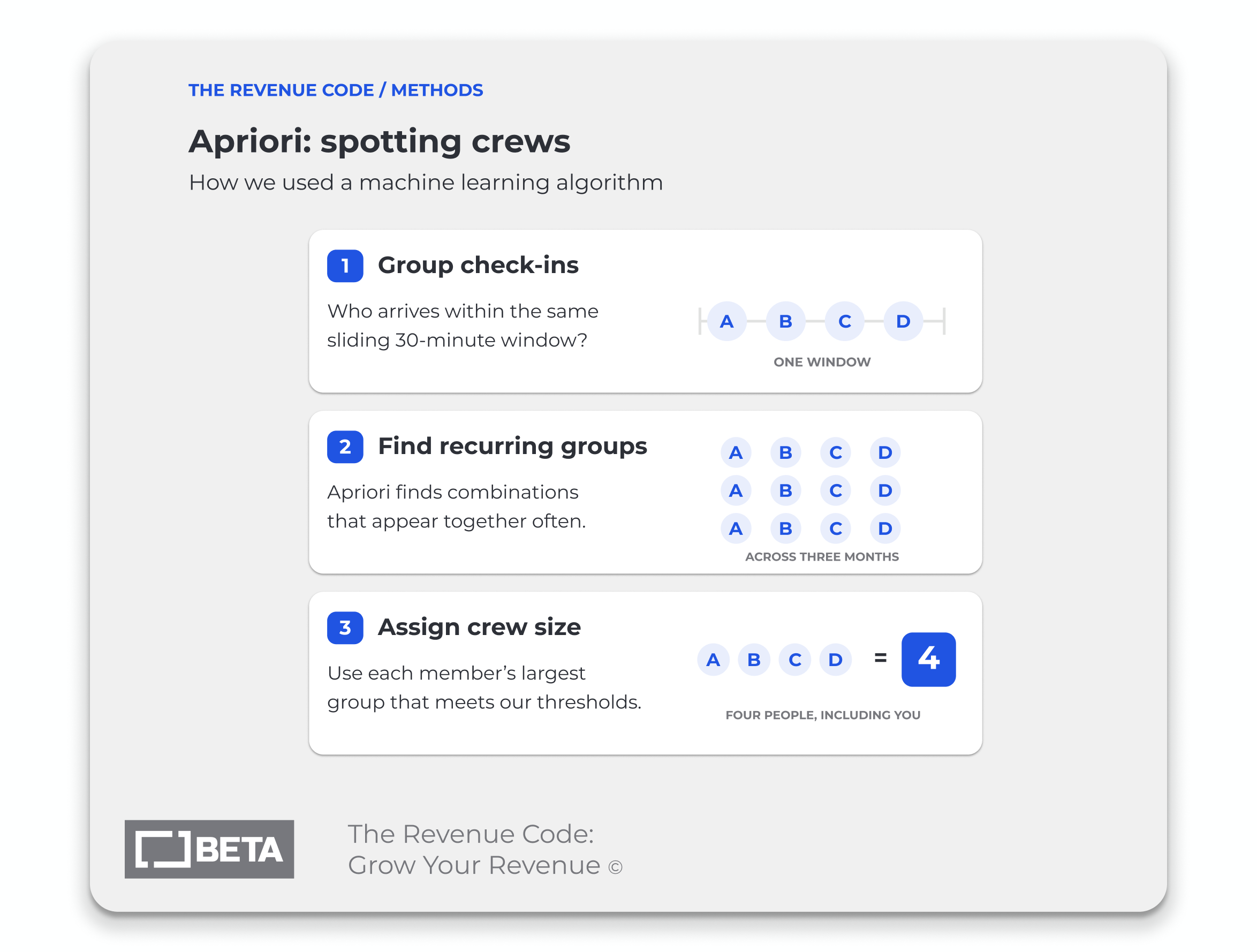
We created session profiles by taking sliding 30-minute windows of membership-linked check-ins for each facility in our dataset over the course of 3 months. We ran Apriori on these session profiles to look for people who consistently checked in around the same time, essentially answering the question, "If person A is here, how likely is person B to be here too." We set thresholds for minimum frequency and likelihood of shared sessions and then tallied up the number and sizes of crews at each gym in our cohort.
We assigned each member a crew size equal to the number of people in the largest group in which they consistently appeared. This meant that I could be a part of a crew of size 4 if 80% or more of the time I climb with the same 3 other people, while those other people could be assigned smaller or larger crew sizes based on their own attendance profiles. We looked at the distribution of crew sizes across all members at the various locations.
Finally, we compared the results at the locations with the highest and lowest retention rates.
A Surprising Result
The first time we ran the algorithm, we found the kids' clubs. This was a good validation that the algorithm was finding the kinds of trends we were looking for, but it wasn't what we were after, so we excluded any entries linked to events and reran it.
Not only was my hypothesis completely incorrect within our dataset, in fact the opposite seemed to be true:
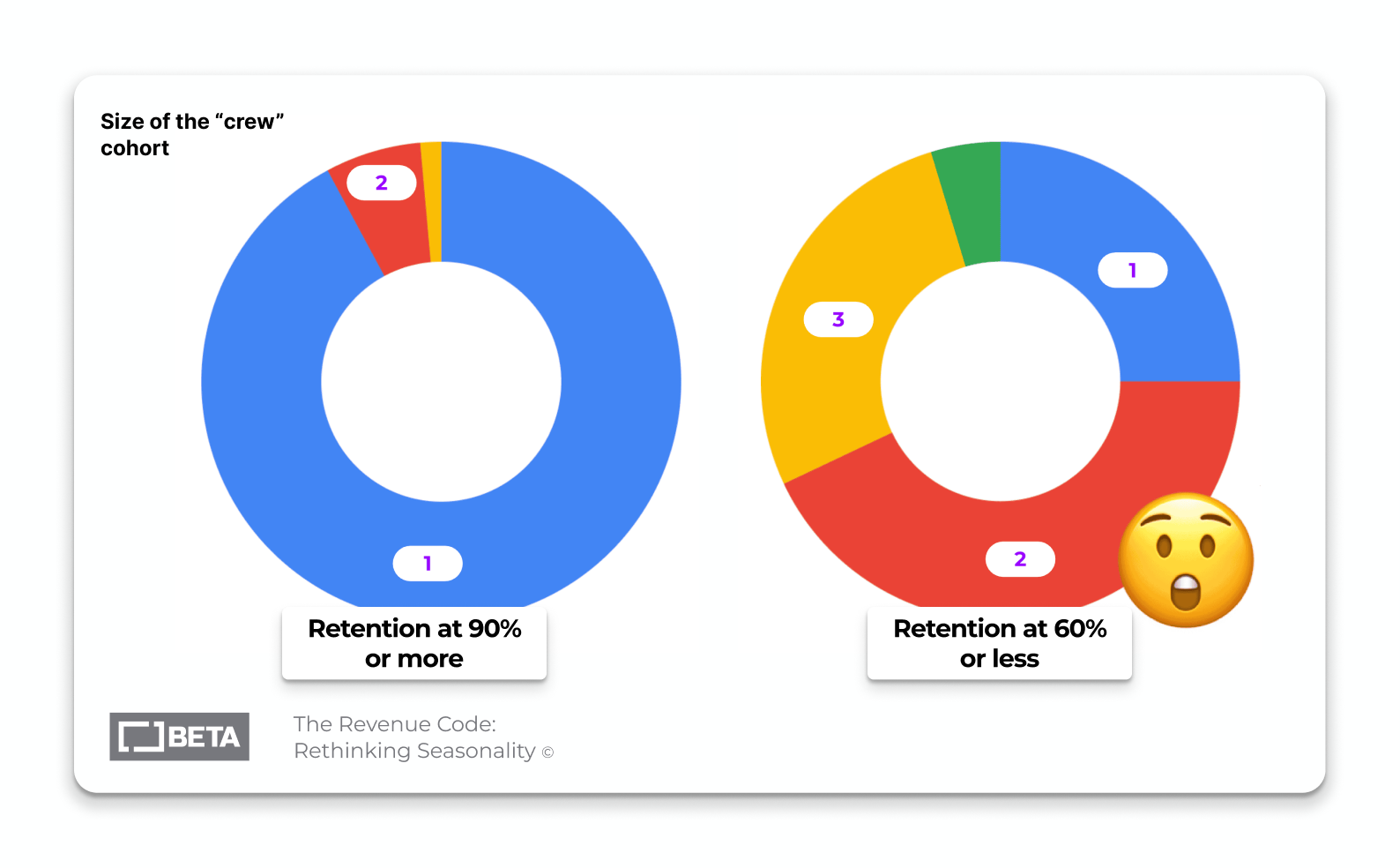
the locations with the highest retention rate actually had the fewest and the smallest crews,
and the locations with the lowest retention rate actually had the most and largest crews.
The trend held across facility sizes and offerings (both rope and boulder facilities).
What do High-Retention Facilities have in common?
Facilities with a 90% or higher retention rate showed a very small percentage of members who consistently climbed with a partner, so a crew of two. And there was a tiny sliver of members who consistently climbed in groups of threes. But there were no larger groups amongst any of the high-retention facilities, most people set their climbing schedules independently of others.
What do Low-Retention Facilities have in common?
Facilities with a 60% retention rate or lower saw that almost three-quarters of members were climbing as part of a consistent crew. Most of these crews were small with two or three people, but we saw several four-person crews at these facilities as well. Very few people at these low-retention facilities were climbing independently of others.
A Fresh way to think about Community
What might these check-in patterns tell us, and what can’t they tell us about community?
Part one: When Crews Become Cliques...
Thinking more about this result, we considered three possible explanations. We haven’t tested these explanations directly, but they raise useful questions for gym operators:
- Othering. When a newcomer enters the facility for the first time and sees a bunch of insular groups, he or she might not feel totally welcome. "The groups are set, and I'm not part of them."
- Leader Impact. Each crew likely has a social force keeping them together: the person who organizes the group chats, who initiates the post-session drinks. What happens when this crew leader decides climbing isn't for him any more? When she gets an injury and is out for a few weeks? The rest of the crew is very likely to drop out as well as the motivating force was external and has now disappeared.
- Driving Force for Retention. If the primary reason for someone to renew their membership is that they get to climb with the same people week through week, it might be an indication that something else is missing. Maybe your holds are old or your setting feels unsafe or unwelcoming. Maybe your staff is rude. If there are fewer negative aspects of your space, perhaps the space itself becomes motivation enough for people to show up, rather than needing a friend to endure it.
How easy is it for someone arriving alone to feel part of your gym?
The takeaway here is that a healthy membership base might not be reflected in the singular bonds people form with others at the gym, but instead in the wider atmosphere curated at the facility.
Rather than people identifying as members of their small crew or clique that keeps them motivated to return, at healthier gyms the members might be showing up because they love the setting and the music and feel psyched to climb regardless of who is going to be there.
Based on this finding, I'd challenge us all to think a bit more about how we encourage community in our gyms. The climbing community is precious and we shouldn't sacrifice that. But neither should we assume that as long-term members of the global climbing community we have the same experience as our typical customer. Don't let community be a crutch that you fall back on to justify stinky bathrooms or a sub-par class offering.
The opportunity is to create an experience worth returning for, whether or not someone’s usual climbing partners are there.
Some audience members at the talk in Rotherham proposed that the way to curate community starts with the staff. A welcoming attitude, a supporting cheer, and equal and enthusiastic attention to everyone who steps foot into the door might be great places to start.
What could your team do this week to help a first-time visitor feel included?
Part two: More Findings on Community
We also had a very quick look at things like diversity and whether or not centres offered a pay-what-you-can scheme. As can be seen in almost every industry worldwide, higher diversity corresponded with higher revenue and higher retention rates.
If you walk into any building and see only (completely random example 😉) white men in their mid-20's, unless you're a white man in his mid-20's, you probably have an immediate reaction of wondering whether you are in the right place. If they all work in tech, and you do something else, then this question might take a few conversations to pop up but it inevitably will.
The more different types of people we can get into our facilities, the more people will feel comfortable in our spaces and the larger our pool of potential members will be. Having pro-diversity policies and schemes, in addition to being a good thing for humanity, is great for the bottom line.
Final Notes
As we wrap up the series, I want to go back through some of the topics we've discussed. First we looked at seasonality and some encouraging datapoints that indicate that summer doesn't have to be the gloomfest we make it out to be. We moved on to overall revenue trends, learning that a focus on membership is crucial for maximizing revenue. Following up on that, we looked into some key characteristics of members likely to renew and some tips for maximizing the lifetime value of a customer. And finally we discussed this ever-burning topic of community in this post.
What does this mean for climbing gym retention?
For gym operators, the practical takeaway is to look beyond the presence of regular crews when assessing community. Consider how your space welcomes someone arriving alone, how staff help newcomers feel included, and what makes the experience worth returning for.
Climbing gyms are complex ecosystems of people, processes, physical space, and experience.
An old adage in data analysis states that there's no such thing as a perfect model, only a useful one. We hope that we have provided some useful ways of looking at data in this series, but none of our models is perfect. Every gym is unique in its offering, location, and resources, and the best way to make positive change in your performance is with a combination of data, industry knowledge, and your own expert understanding of your local dynamics and vision.

At BETA, we provide expertise in the data & industry knowledge, and I would encourage anyone who feels their software doesn't provide those things to consider the big scary migration.
But only you know the particularities of your space, which data points to ignore, and on which to place a higher importance.
Let's speak, and superpower your gym
Book a demo and we will walk you through BETA, built by climbers for climbing gyms.
Book a DemoThanks for joining us! We hope to do more series like this in the future and appreciate any and all feedback and conversation you feel inspired to provide, feel free to reach out and happy climbing!

Written by Miura Hawkins
CEO & Founder at BETA climbing
Part of The Revenue Code Series