The Revenue Code: Rethinking Seasonality, Part 2 of 5
Summer comes every year, but is your gym ready? Explore climbing industry seasonality, and discover how facilities prepare for the highs, lows, and summer slump.
Welcome back to our Revenue Code series. If you haven’t already read our series intro, you can learn more about our methods and goals here.
Written by Miura Hawkins
CEO & Founder at BETA climbing
One thing we can’t deny in our industry is that times are changing. We’ve been very lucky that climbing has had its 15 minutes of fame. Just a few short years ago it seemed like everyone and his cousin was opening a climbing gym. It was enough to know how to turn an allen wrench (or use an impact driver for my younger audience) and tie a double-figure-8: If you build it, they will come.
It’s not enough any more.
We’re not just competing with the 10 new climbing facilities that have opened in our vicinity. We’re competing with Hyrox, with yoga, with SoulCycle. Honestly, we’re competing with La-Z-Boy and TikTok.
I liken it to the era of vibe-coded apps. Anyone can make an app these days. So why hasn’t this tangibly changed the availability of software products? It turns out the hard part wasn’t prototyping an app. It was deciding which features to prioritize, solving an actual need, and building a message to support the mission.
The person running your marketing campaigns needs to be an expert in the tools and processes of marketing. The person setting your routes needs to be an expert in the tools and processes of routesetting. And the person making your business decisions needs to be an expert in the tools and processes of business performance analysis. If you are one of these people and you don’t have the relevant expertise, hire someone who does or upskill. Those are the only options if you want your business to survive the next 5 years.
› Seasonality
So, let’s talk about an area where gyms with a high degree of professionalism, expertise and analytics are doing well and where the ones who are less proficient are suffering.
I don’t know a single owner or manager in the indoor climbing space who hasn’t lamented or celebrated the turning of the seasons. As an industry we have a strong tendency to view our revenue streams as having a necessary reliance on the weather. Well, I’d like us to reconsider.

When I gave this talk at the Association of British Climbing Walls conference two weeks ago, I asked the audience of gym owners and managers which month of the year they thought would be the worst for industry performance and which would be the best. The answers were all over the calendar, with folks guessing that the worst months would be June, July or December and that the best months could be anything from January to August.
Curious on another take on this talk?
Review the report from Rise Above Consulting below for additional ideas on what a gym might do to counter seasonality.
 gheverly

› The Cohort as a Whole
First we decided to look into the answer to this question on a comprehensive scale by including data from all 32 gyms who participated. We took the total revenue for all businesses in the cohort and calculated the monthly deviation from the mean, so the percentage by which the revenue in each month differed from the average revenue across all 12 months in the year. For each year, we only included businesses that were active across all 12 months of the year (or all months up through August for 2026).
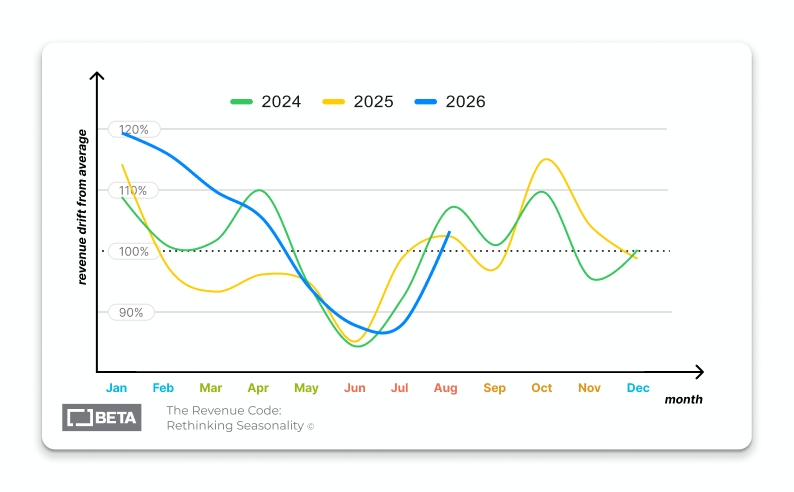
Indeed in this view we saw a consistent low point in June each year. December was also consistently poor, especially when compared to its nearby local peak in October and the eternal winner in January.
While overall there was nothing too surprising here, we did take note of the fact that each year since 2024 (and in fact this trend even continued when looking further into the past at 2023 and 2022), the January peak had grown a bit larger.
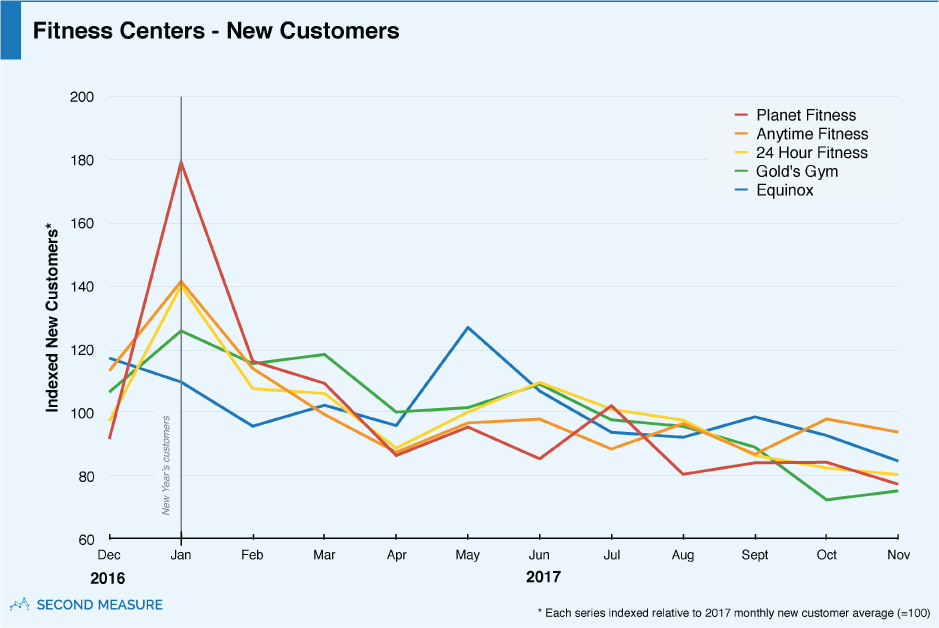
This immediately made us think of the traditional fitness industry, where the New Year’s Resolution is king. It seems that as our industry professionalizes, we’re doing a better job of emulating this January peak. More on that later.
We also noticed that the local peaks seemed to be flattening out through the years. 2024 had strong local peaks in April, August, and October, and while 2025 saw similarly-timed peaks, their magnitude and difference to their neighboring troughs was relatively subdued.
In 2026 the local peak in April and local trough in February are completely gone — replaced by a smooth decrease in revenue from January to June. To me, this is a good thing. It indicates that gyms might be taking a more active role in setting and achieving revenue goals, rather than just letting the patrons come to them when they will.
› A Different Perspective
But this couldn’t be the whole story. We wanted to understand if the peaks and troughs were universal or if there was variance between the different businesses in the cohort.
We took the data for the past 12 months, from September 2025 to August 2026, and again took the deviation in revenue for each month from the mean across all months. But this time we looked at revenue deviation per business, not overall.
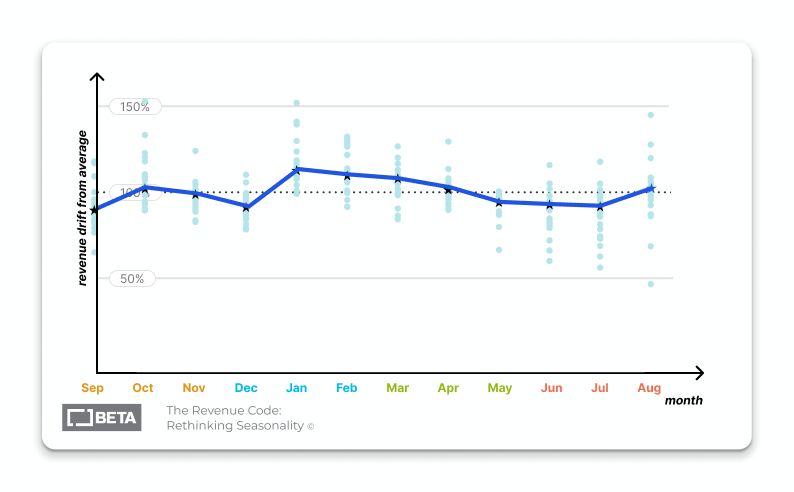
Here’s where the data began to demonstrate a difference between businesses: all of the audience members who took a venture at a guess for the worst and best months were right. In fact, January was the only month of the year in which not a single business had its worst month. And conversely every single month of the year was represented in individual businesses’ best month. Yes, even June. Even December.
So in every month in which someone had their worst month, someone else was having a great month or even their best month.
We wanted to know more.
While typically the lost revenue in the low months tended to come from a drop in day entry sales, we wanted to know what it was that was dampening this effect or making up for it in businesses that weathered the troughs well. First we tried to calculate a “revenue smoothness score” by looking at the standard deviation of the revenue drift across the 12 months for each business. We attempted to correlate this with the percentage of revenue coming from various sources (i.e. memberships, day entries, events, cafe, shop, etc. — more on this in next week’s post). We attempted to correlate it with gym size in financial terms and in terms of visitors. With urban vs rural location. With membership retention rates.
None of the measures we investigated had a significant correlation with revenue smoothness.
Not willing to give up, we tried something else. We looked at “trough resilience”, calculating a score for how well individual businesses fared in months where the entire cohort did poorly. First we looked only at the June slump and then across all slumps. We tried to correlate these scores again to the other metrics we had collected.
Nothing.
"The only metric that came close to having a statistically-significant correlation with a higher performance during the traditional slump times was a more competitive location, and even that correlation was weak and had plenty of counter-examples. "
One explanation for this could be that gyms in areas with more gyms nearby build off each other to create a more stable customer base. Another explanation could be that faced with more competition, we’re forced to try harder.

› What Does This Mean?
What this tells me is that there’s not one answer to surviving the low season. This is great news. It means that you can play to your strengths, be creative.
As climbers, we love to make excuses: “These shoes don’t have the right edge for that foot.” “I’m too short for this move.” Or our eternal favorite: “The conditions are no good.”
It’s so easy to blame external factors, shirking any kind of responsibility for poor performance.
But from our dataset it’s clear that it’s very much possible to have a strong June, a strong December. If there’s one thing we can be sure of, it’s that June will come next year. Don’t give into the temptation to sit back and mope. Have a plan. Implement it. Measure it. And adjust.
As a coach, I always emphasized the importance of managing the waves of motivation to my athletes.
The number one most important thing is showing up on the days you don’t want to. I doubt you’ll find a coach or athlete who disagrees with this point. Those who show up consistently, even on high gravity days or when the sun is shining, are the ones who will grow the most, without fail. For us this means showing up in June with a plan and a smile, even when we don’t want to.
But second-most-important is to take the days where motivation is high and to squeeze every last drop from them. I believe we’re already starting to do this as we see the January peak growing. People are excited to get back into the gym after the holidays. Help them turn this excitement into a habit that will last throughout the year.
My own coach gave me a tangential lesson that I think about often: Once when arriving to practice having forgotten my shoes, I begrudgingly donned a pair of rentals. I fell off my project. Back on the ground, my first comment was about how the rental shoes prevented me from using the foot on the crux move properly.
“A poor workman blames his tools.”
was his only response.
While having the right tools for the job is important, there are a million other factors at play at any given time. We’re always going to be limited by some external factor. We cannot control the weather, and in fact it’s getting more unpredictable by the month. We cannot control how much disposable income is available to our would-be customers. But for each factor we can’t control, there are several that we can: Summer offerings, special events, for whom we build our space and pricing structure.
I myself have recently been a benefactor of one such initiative:
When faced with a looming summer with an injured belay partner and record heat projections, I saw a summer membership offer that I just couldn’t pass up. So for the first time in my entire life, I bought myself a membership to a climbing gym. And you know what? I used it. I went to the gym almost every week. And when September rolled around, I renewed it into an annual membership.
These things work.
› Wrapping Up
The audience helped paint some more color for us here. They tended to see an uptick from back-to-school promotions in the autumn. This could explain the strong October, but not the abysmal September that was actually the worst month overall amongst the past 12. Maybe we can do better to harness that back-to-school energy even earlier and turn it into a second January.
We provided one more angle to back up the claim that it’s not just the weather.
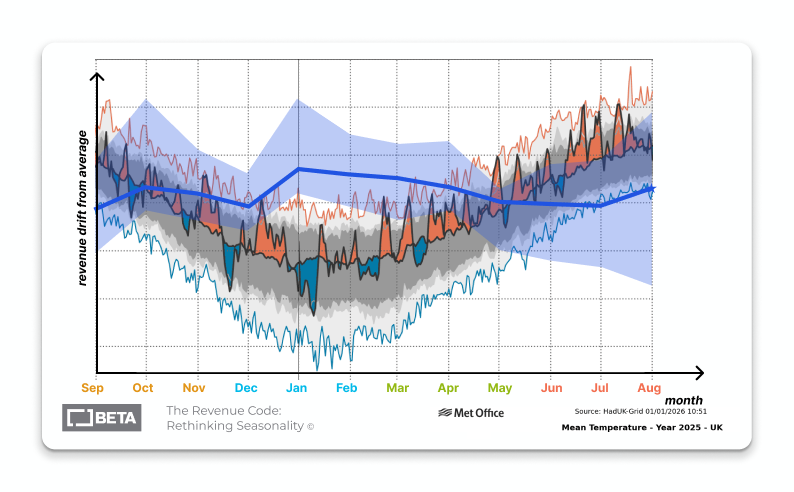
If the weather were the only factor here, we would see a revenue line that perfectly mirrored the temperature. But we don’t. The line undulates within the seasons — September, October, and December are three clear examples of months that deny the weather trend from ruling.
So let’s make a pact: No more excuses.
Check your data, understand what drives your revenue to drop in your low months, and make a plan to supplement it with new initiatives.
Wondering what your data says and how to connect it to improved seasonal performance?
Book a Free Demo
Written by Miura Hawkins
CEO & Founder at BETA climbing
Part of The Revenue Code Series